Statement
Meia’s practice investigates perception as a constructed condition rather than a passive act. Drawing from a background in aerial photography, fine cuisine, and high-end tattooing, his work is grounded in precision, control, and procedural discipline. These fields inform a methodology where execution is inseparable from concept, and surface becomes a site of investigation rather than representation.
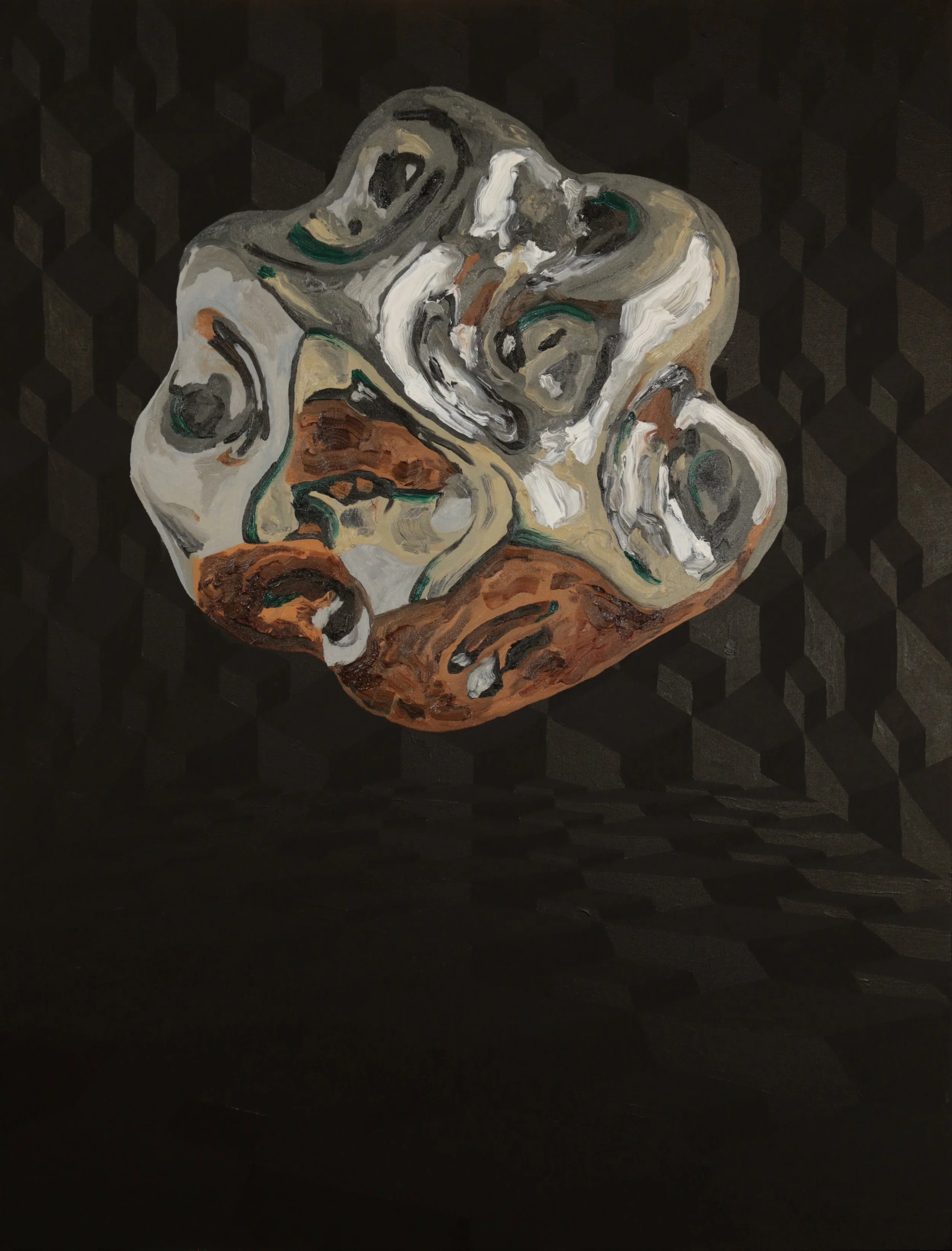
His paintings operate as spatial systems rather than images. Central to this inquiry is the use of chrome—an element without intrinsic color or fixed identity, whose existence is contingent on its surroundings. Reflection is not employed as illusion, but as a functional mechanism that reveals the instability of visual perception. What is seen is not depicted, but produced through the interaction between object, environment, and viewer.
The viewer is not positioned as an observer but as a variable within the work. As their presence alters the reflected field, perception becomes contingent, fragmented, and continuously reconfigured. The work resists fixed interpretation by design; it does not resolve into image, but remains in a state of perceptual negotiation.
The process begins with digital constructions that translate structural logic into form, developed through layered applications of oil and acrylic. Each decision is governed by maintaining perceptual tension rather than expressive resolution. Within this framework, the work does not communicate emotion or narrative, but functions as an evidentiary object exposing the conditions under which perception occurs.